

 Free Demo
 1 Kundenrezensionen

Simulierte Prüfung der 3V0-12.26 beseitigen Ihre Angststörung
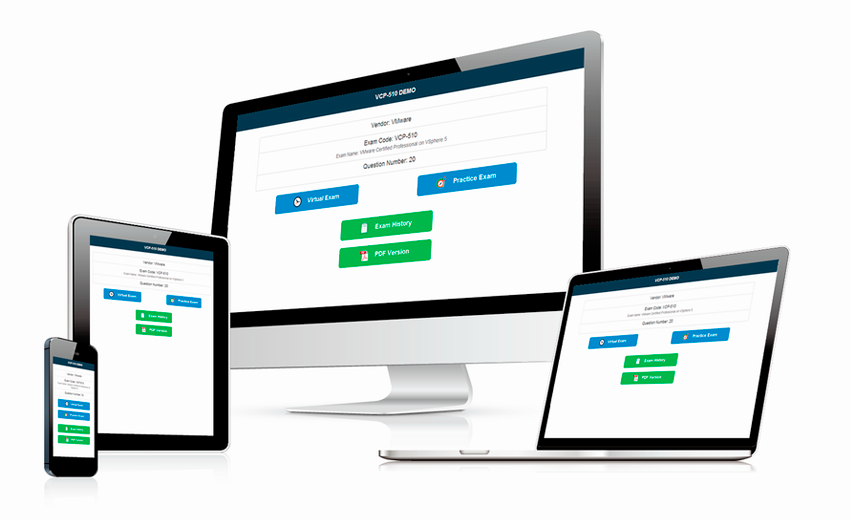
Man sagt: Übung macht den Meister. Je mehr Prüfungsaufgaben der 3V0-12.26 Sie geübt haben, desto mehr Angst vor VMware 3V0-12.26 wird beseitigt. Daher haben wir für Sie die Simulations-Software der 3V0-12.26 entwickelt. Sie können damit die Atmosphäre der Prüfung besser empfinden. Mit genügenden simulierten Prüfungen werden Sie sich mit der VMware 3V0-12.26 auskennen und mehr Selbstbewusstsein daher bekommen.
Neben den genannten Versionen der VMware 3V0-12.26 bieten wir Ihnen noch Online Test Engine. Die kostenlose Demo aller drei Versionen können Sie auf unserer Webseite herunterladen und sofort probieren. Wir glauben, dass die hohen Standard erreichende Qualität der 3V0-12.26 Ihre Erwartungen nicht enttäuschen werden. Allerdings erreicht die Prozentzahl von unseren Kunden, die schon VMware 3V0-12.26 bestanden haben, eine Höhe von 98%-100%.
Die besten Hilfe der 3V0-12.26 einfach benutzen
Möchten Sie jetzt die zuverlässige VMware 3V0-12.26 besitzen? Sie können jetzt einfach online durch CreditCards oder mit anderem gesicherten Zahlungsmittel bezahlen. Wenn die Bezahlensinformationen bestätigt werden, schicken wir umgehend Ihnen 3V0-12.26 per E-Mail. Sie können sofort die VMware 3V0-12.26 genießen!
Bessere Fachkenntnisse über 3V0-12.26 schnell beherrschen
Die VMware 3V0-12.26 von uns enthält eine große Menge von neuesten Prüfungsunterlagen, die von unsere IT-Gruppe forgfältig analysiert werden. Fast jeder Frage in 3V0-12.26 folgen ausführliche Erläutungen der Antworten. Mit der PDF Version der Prüfungsunterlagen können Sie irgenwo und irgendwann mit der VMware 3V0-12.26 wiederholen. Auf diese Weise werden Sie die Fachkenntnisse schnell beherrschen ohne Zeitaufschwendung.
Extra Kundendienst für 3V0-12.26
Unser Unternehmen ist sehr bekannt für Ihr großes Verantwortungsbewusstsein. Nachdem Sie für 3V0-12.26 bezahlt haben, bieten wir Ihnen weiterer Kundendienst. Um die neueste Tendenz der Prüfung zu folgen, aktualisieren wir die VMware 3V0-12.26 rechtzeitig. Danach schicken wir Ihnen die neueste Version der Prüfungsunterlagen per E-Mail automatisch. Der Aktualisierungsdienst der 3V0-12.26 ist innerhalb einem Jahr nach Ihrem Kauf ganz gratis.
Wir sind verantwortlich für die Wirksamkeit der VMware 3V0-12.26. Falls Sie mit Hilfe von 3V0-12.26 noch leider nicht die Prüfung bestehen. Schicken Sie bitte das Zeugnis! Wir werden nach der Bestätigung Ihnen die volle Rückerstattung geben so schnell wie möglich. Wir sind kompetenter und hilfsreicher Partner für Sie. Sie können sich unbesorgt auf uns verlassen!
Einfach und bequem zu kaufen: Um Ihren Kauf abzuschließen, gibt es zuvor nur ein paar Schritte. Nachdem Sie unser Produkt per E-mail empfangen, herunterladen Sie die Anhänge darin, danach beginnen Sie, fleißig und konzentriert zu lernen!
Die Wichtigkeit und Schwierigkeit der VMware 3V0-12.26 ist weltweit bekannt, und mit der internationalen Zertifizierung der 3V0-12.26 macht Ihre Jobsuche in der IT-Branche sicherlich leichter. Deshalb streben wir danach, Ihnen besten Hilfe zu bieten, um VMware 3V0-12.26 zu bestehen.

VMware 3V0-12.26 Prüfungsthemen:
| Abschnitt | Ziele |
|---|---|
| Thema 1: Planung und Gestaltung von VMware Cloud Foundation Lösungen | - Architektur unter Berücksichtigung von Verfügbarkeit, Leistung, Sicherheit und Wiederherstellbarkeit - Entwurf konzeptioneller, logischer und physischer Lösungen - Übertragung von Geschäftsanforderungen in eine technische Architektur |
| Thema 2: VMware Cloud Foundation Produkte und Lösungen | |
| Thema 3: Fehlerbehebung und Optimierung der VMware Cloud Foundation-Architektur | |
| Thema 4: IT-Architekturen, Technologien, Normen | |
| Thema 5: Installation, Konfiguration und Verwaltung von VCF-Architekturelementen |
VMware Advanced VMware Cloud Foundation 9.0 Architect 3V0-12.26 Prüfungsfragen mit Lösungen
An architect is designing the physical and host networking architecture for vSAN Express Storage Architecture (ESA) in a VMware Cloud Foundation (VCF) deployment.
The customer requires maximum storage performance for latency-sensitive, high-IOPS workloads in analytics, artificial intelligence (AI), and machine learning (ML). To achieve this, the design must incorporate Remote Direct Memory Access (RDMA) over Converged Ethernet (RoCE v2) for vSAN data traffic while maintaining a converged network for all other VCF traffic types.
During requirements gathering, the customer specified the following technical requirements:
* Ultra-low latency and maximum throughput for vSAN data traffic.
* Support for Priority Flow Control (PFC) to ensure lossless Ethernet for RoCE v2 traffic.
* Deterministic performance with no dynamic load balancing that could introduce variability in storage I
/O paths.
* End-to-end jumbo frame support across the fabric.
* High availability with tolerance to single NIC or switch failures.
* Converged design where RoCE v2 vSAN traffic is separated by the physical infrastructure with management, vMotion, and NSX overlay traffic traversing a secondary network.
Given these RDMA-enabled vSAN networking requirements in a multi-rack VMware Cloud Foundation (VCF) environment, what are the three key design decisions? (Choose three.)
- A. Use Load-Based Teaming on the vDS for vSAN RDMA VMkernel ports to maximize utilization of multiple RDMA-capable uplinks.
- B. Configure vSAN VMkernel ports to use RDMA (RoCE v2) with a dedicated vSphere Distributed Switch teaming policy of Active/Standby and explicit failover order.
- C. Implement a leaf-spine topology with DCB (Data Center Bridging), including Priority Flow Control PFC on specific Class of Service (CoS) profiles.
- D. Each ESX host with at least four 100 GbE RDMA-capable NICs two dedicated for RoCE vSAN traffic and two for other converged traffic types.
- E. Each ESX host with at least two 10GbE RDMA-capable NICs two dedicated for RoCE vSAN traffic and two for other converged traffic types.
- F. Enable jumbo frames MTU 9190 end-to-end and configure PFC for lossless behavior.
Antwort: B,D,F 🗳️
Erklärung: (Nur für ExamFragen-Mitglieder sichtbar)
An architect is designing a new VMware Cloud Foundation (VCF) solution. During a workshop with the customer, the architect collected the following high-level information:
* The solution must provide 99.9% availability, measured yearly.
* The solution must initially support 2000 virtual machines.
* The solution must scale to support 8000 virtual machines within six months.
* The solution must provide a Recovery Point Objective of 2 hours.
Based on the information provided by the customer, which two assumptions should the architect make to help with resource sizing for the solution? (Choose two.)
- A. The amount of CPU, RAM, and storage resources of an average virtual machine.
- B. The backup solution used to protect virtual machines.
- C. The average resource utilization of a virtual machine.
- D. The Distributed Resource Scheduler is configured on the vSphere cluster level.
- E. The guest operating system used by each virtual machine.
Antwort: A,C 🗳️
Erklärung: (Nur für ExamFragen-Mitglieder sichtbar)
An architect has been engaged to design a new VMware Cloud Foundation (VCF) deployment for a customer that will provide platform-level high availability across three data centers to support their applications.
The customer has advised that there is high-bandwidth connectivity of 10 Gbps+ between the data centers, with less than 5 ms Round Trip Time (RTT) between each site, supporting a combination of Layer-2 and Layer-3 capabilities.
The customer has provided the following additional requirements:
* A mix of Tier-1 (mission critical), Tier-2 (business critical), and Tier-3 (business operational) applications.
* Tier-1 and Tier-2 applications require a Recovery Point Objective (RPO) of zero .
* Compliance with all data sovereignty regulations.
* Operational complexity must be reduced where possible.
* Maximum Recovery Time Objective (RTO) of 24 hours in the event of a regional failure.
Given this information, which design should be recommended for the customer?
- A. VCF Fleet with Multiple Sites in a Single Region plus Additional Region(s).
- B. VCF Fleet with Multiple Sites in a Single Region.
- C. VCF Fleet in a Single Site.
- D. VCF Fleet with Multiple Sites across Multiple Regions.
Antwort: A 🗳️
Erklärung: (Nur für ExamFragen-Mitglieder sichtbar)
An architect has been tasked with designing the storage components of a VMware Cloud Foundation (VCF) solution. The following information has been provided about the solution by the lead architect:
* There will be a single VCF Instance within the Fleet.
* The VCF instance will have a single Workload Domain with a single cluster.
* The VCF Workload Domain requires a multiple tier storage solution consisting of:
* A highly scalable, policy-based storage solution for critical application workloads.
* A file-based storage solution that can scale independently of the cluster for workloads with large data requirements.
VCF installer will be used to deploy the environment.
Which two design decisions should the architect make for the VCF Workload Domain? (Choose two.)
- A. Use NFS v4.1 as the principal storage solution for the VCF Workload Domain.
- B. Use iSCSI as the principal storage solution for the VCF Workload Domain.
- C. Use VMware vSAN as the principal storage solution for the VCF Workload Domain.
- D. Use NFS v3 as the supplemental storage solution for the VCF Workload Domain.
- E. Use FC as the supplemental storage solution for the VCF Workload Domain.
Antwort: C,D 🗳️
Erklärung: (Nur für ExamFragen-Mitglieder sichtbar)
An architect is designing a standardized VMware Cloud Foundation (VCF) environment with VMware NSX for multiple workload domains. The architect chooses to specify the default NSX segment profiles as part of the VCF design baseline rather than creating custom profiles.
Why would an architect specify the default NSX segment profiles in a VCF design?
- A. Default segment profiles offer enhanced network performance and are automatically optimized for overlay network traffic.
- B. Default segment profiles provide sufficient security, operational baseline settings and simplify lifecycle management.
- C. Default segment profiles enable distributed firewall policy enforcement and avoid the need for overlay segments.
- D. Default segment profiles are required for VLAN-backed segments and cannot be overridden.
Antwort: B 🗳️
Erklärung: (Nur für ExamFragen-Mitglieder sichtbar)












Bebel -
Habe schon die 3V0-12.26 Prüfung bestanden. Sogar in beschränkter Zeit kann ich mich mühlos auf die Prüfung vorbereiten und einmalig bestehen. Vielen Dank!